Chapter 1
Translation,;,。
Hover, focus, or tap a character for its reading and sense.
The Tao that can be trodden is not the enduring and unchanging Tao. The name that can be named is not the enduring and unchanging name.
道德經
Laozi · c. 4th century BCE
Softness overcoming hardness, and the power of yielding.
Eighty-one verses on the Way, on wu wei (effortless action), and the strength of water.
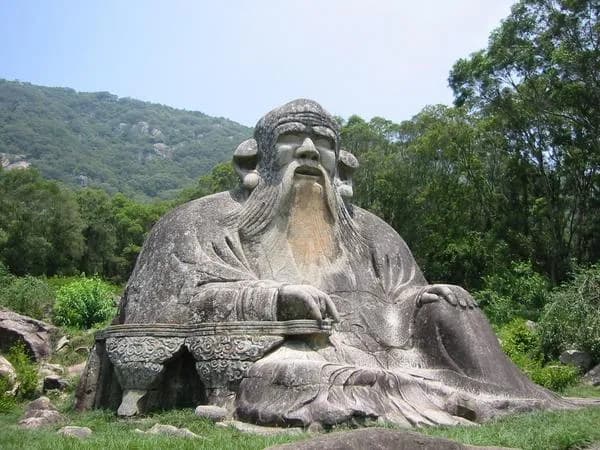
The Tao Te Ching argues that the world works best when we stop forcing it. Its hero is water: soft, low, yielding, and yet able to wear down stone. Its method is wu wei, action that flows with circumstances rather than against them.
Tradition says Laozi was an archivist of the Zhou court who wrote the text at a mountain pass before disappearing to the west. Scholars now see it as a compilation from the Warring States period. It is among the most translated books in the world, and it shaped Chinese painting, poetry, medicine, and Chan (Zen) Buddhism.
The nameless source and pattern of all things. The moment you define it, you have lost it.
Not passivity, but acting without strain, like a swimmer who uses the current.
The quiet potency of someone in harmony with the Way.
Simplicity before shaping; potential not yet spent.
Each passage is cited and credited. Classical lines open character by character: the reading, the sense, and what is hiding inside a single character. Paraphrases are marked where the best translations are still under copyright.
,;,。
Hover, focus, or tap a character for its reading and sense.
The Tao that can be trodden is not the enduring and unchanging Tao. The name that can be named is not the enduring and unchanging name.
。,,。
Hover, focus, or tap a character for its reading and sense.
The highest excellence is like that of water. The excellence of water appears in its benefiting all things, and in its occupying, without striving to the contrary, the low place which all men dislike. Hence its way is near to that of the Tao.
,。
Hover, focus, or tap a character for its reading and sense.
When the work is done, and one's name is becoming distinguished, to withdraw into obscurity is the way of Heaven.
,,。
Hover, focus, or tap a character for its reading and sense.
Clay is fashioned into vessels; but it is on their empty hollowness, that their use depends.
,。,。
Hover, focus, or tap a character for its reading and sense.
He who knows other men is discerning; he who knows himself is intelligent. He who overcomes others is strong; he who overcomes himself is mighty.
。
Hover, focus, or tap a character for its reading and sense.
The Tao in its regular course does nothing for the sake of doing it, and so there is nothing which it does not do.
;。,。
Hover, focus, or tap a character for its reading and sense.
There is no calamity greater than to be discontented with one's lot; no fault greater than the wish to be getting. Therefore the sufficiency of contentment is an enduring and unchanging sufficiency.
,。,;,。
Hover, focus, or tap a character for its reading and sense.
The master anticipates things that are difficult while they are easy, and does things that would become great while they are small. All difficult things in the world are sure to arise from a previous state in which they were easy, and all great things from one in which they were small.
,;,;,。
Hover, focus, or tap a character for its reading and sense.
The tree which fills the arms grew from the tiniest sprout; the tower of nine storeys rose from a small heap of earth; the journey of a thousand li commenced with a single step.
,。
Hover, focus, or tap a character for its reading and sense.
Man at his birth is supple and weak; at his death, firm and strong. Thus it is that firmness and strength are the concomitants of death; softness and weakness, the concomitants of life.
,。
Hover, focus, or tap a character for its reading and sense.
There is nothing in the world more soft and weak than water, and yet for attacking things that are firm and strong there is nothing that can take precedence of it.
A modern translation
In a culture of hustle, the Tao Te Ching is a radical argument for timing, restraint, and leverage. Sometimes the strongest move is to stop pushing.
Map it onto your own decision